




 Technology20 Jun 2026
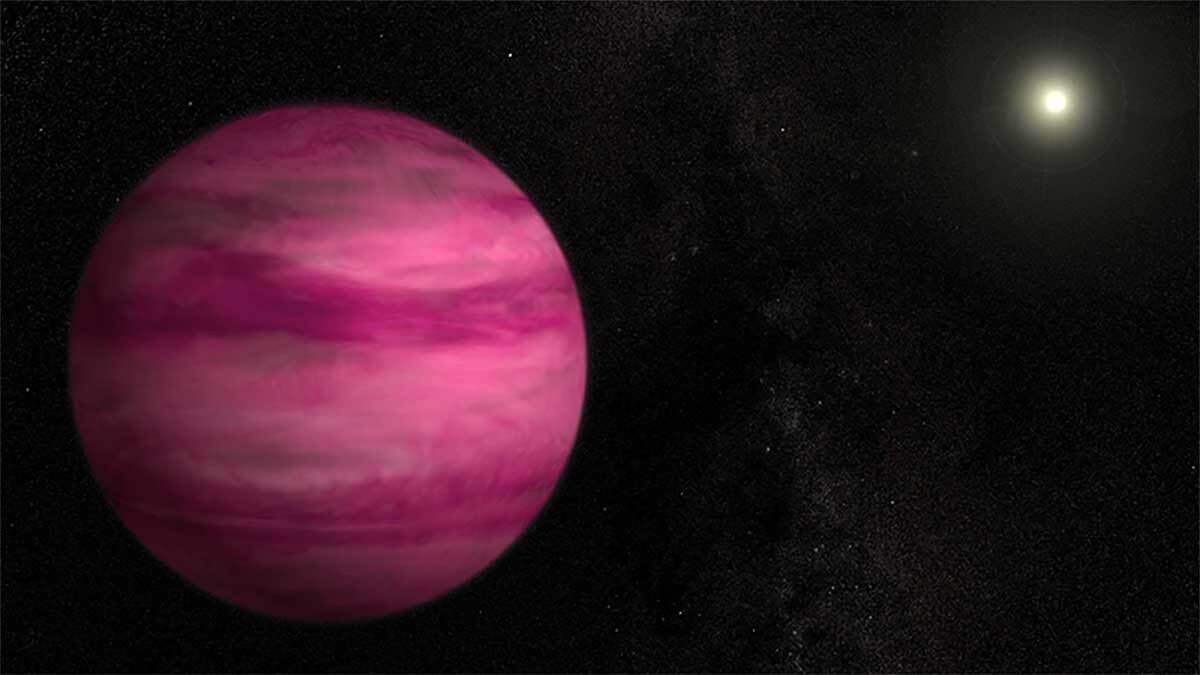
Astronomers Discover Pink Alien World GJ 504 b with Unique Salt Clouds
Astronomers unveil GJ 504 b, a pink alien world with clouds of salt, revealing new insights into its atmosphere and nature.
Astronomical Breakthrough: GJ 504 b Unveiled
Astronomers using NASA's James Webb Space Telescope have made a groundbreaking discovery of an alien world, GJ 504 b, located just 57 light-years from Earth. This distant celestial body displays a fascinating pink hue and contains clouds rich in salt, offering a new window into the atmospheric conditions of exoplanets.
Characteristics of GJ 504 b
Atmosphere and Composition
GJ 504 b, often referred to as the "Pink Planet," may be classified as either a giant exoplanet or a brown dwarf, a small celestial object that failed to ignite nuclear fusion. This planetary-mass companion is estimated to be between 2.5 to 4 billion years old and has a striking temperature of approximately 550°F.
The discoveries surrounding its atmosphere were detailed in a recent study, marking the first time astronomers have been able to capture and analyze the light of GJ 504 b sufficiently to study its atmospheric composition directly as opposed to using indirect brightness measures.
Unique Salt Clouds
One of the most astonishing findings from the observations is the detection of salt clouds in GJ 504 b's atmosphere. Aneesh Baburaj, a Northwestern University astronomer who led the research, noted that while theorists have long predicted the existence of salt clouds on exoplanets, GJ 504 b provides crucial evidence of their presence. "Salt clouds are unusual," Baburaj remarked, emphasizing the novelty of this find.
The clouds most likely consist of alkali metal compounds such as potassium chloride or sulfur compounds like manganese sulfide. This phenomenon occurs when atmospheric gases cool enough to condense into solid or liquid particles, creating microscopic grains that float in the atmosphere and alter the light spectrum received from its host star.
The Significance of GJ 504 b's Findings
Researchers believe that GJ 504 b’s unique attributes, including its faint pink coloration, can be attributed to its salt clouds which filter and modify the starlight that passes through its atmosphere. Despite the planet's relatively low temperature, it is considerably hotter than most other directly imaged exoplanets.
While the new data supplies valuable insights into GJ 504 b’s chemical composition, questions regarding its classification persist. The spectral analysis indicates a rich presence of heavy elements, which can hint at a history of formation from a gas and dust disk around a young star, a process typical for planets.
The Ongoing Debate: Planet or Brown Dwarf?
Despite the detailed findings, the debate regarding whether GJ 504 b qualifies as a planet continues. Researchers are unable to completely rule out the possibility of it being a brown dwarf due to the presence of uncertainties, but if GJ 504 b is indeed a planet, it would be approximately 25 times more massive than Jupiter, the largest planet in our solar system.
The analysis of this pink-hued world not only expands our understanding of exoplanets but also demonstrates the robust capabilities of the James Webb Space Telescope in unlocking the mysteries encased within distant atmospheres. As researchers continue to explore the composition of GJ 504 b, this discovery marks a significant step in the journey to understanding the diversity of celestial bodies in our universe.
Popular news
A small plane crash while touring the Nazca Lines in Peru has resulted in 13 fatalities, including tourists and crew.





Subscribe to
our news
Get the most important updates and top stories in your inbox.