 Technology02 Oct 2026
Astronomers Unveil Secrets of Planetary Collisions Through Stellar Dust Analysis
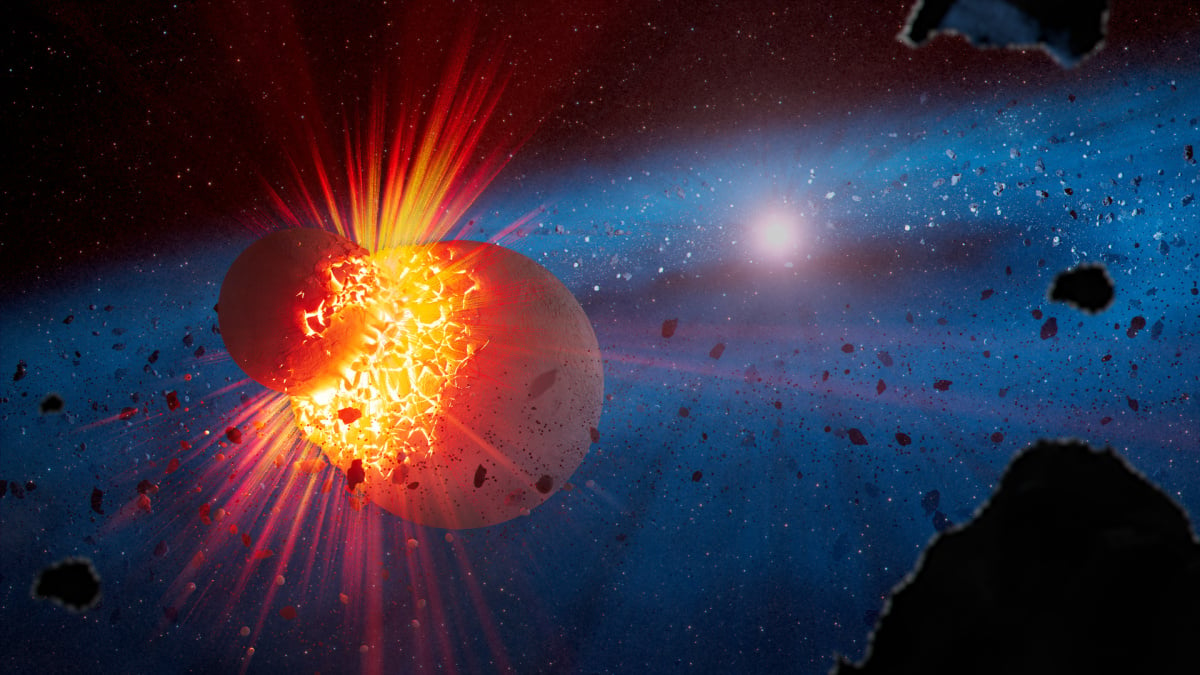
Astronomers studying young star systems found two types of debris from planetary collisions, shedding light on rocky planet formation.
Understanding Planetary Formation Through Collision Debris
Astronomers have made significant strides in understanding how rocky planets form around young stars by analyzing debris from violent planetary collisions. Recent research that examined 21 young star systems has uncovered two distinct types of crash debris. The findings provide a fascinating glimpse into the chaotic processes involved in the formation of terrestrial planets.
The Two Types of Debris
The study, leveraging data from the James Webb Space Telescope, highlights two forms of materials left behind by planetary impacts:
- Silica-rich debris: This type results from high-velocity collisions involving Mars-sized objects, which can vaporize rock on contact, producing clouds of tiny glassy particles.
- Forsterite-rich debris: Comprised mainly of the green mineral forsterite, which is also known in its gem form as peridot, this debris typically originates from less catastrophic grazing collisions.
By identifying the characteristics of the dust in these systems, astronomers can infer the severity and frequency of collisions occurring in these youthful star’s debris disks.
The Role of Extreme Debris Disks
The dust clouds around these young stars are described as "extreme debris disks," where freshly colliding planetary bodies create significant amounts of warm dust. This dust is in the same vicinity as rocky planets like Earth, Mercury, and Mars, suggesting that similar processes may have occurred in our own solar system during its formative years. According to Kate Su, the lead author of the study, "How rocky planets formed and giant planets evolved are part of the broader story of the solar system’s formation."
Insights from the James Webb Space Telescope
Scientists utilized two NASA observatories, including the now-retired Spitzer Space Telescope, to identify these disk systems. At first, Spitzer detected the unusual disks, but it was the James Webb Space Telescope that enabled more detailed observations, essentially doubling the number of systems analyzed. This unprecedented amount of data allowed for a comprehensive understanding of the composition and state of these debris disks.
The researchers guided by Agnes Kospal from Konkoly Observatory revealed that roughly one-third of the studied systems exhibited high silica content, indicating violent crashes. In contrast, the remaining systems primarily contained forsterite, linked to milder collisions.
Implications for Understanding Planetary Systems
The presence of silica debris only around stars younger than approximately 300 million years aligns with models suggesting that rocky planets form rapidly during the early stages of a solar system. As dust in these disks fluctuates in brightness over time, scientists observe that systems rich in sandy dust exhibit significant flickering, potentially indicating that ongoing collisions are influenced by hidden planets that disturb the orbits of smaller bodies.
Histories of such upheaval could mirror events in our solar system's past, particularly during the period when massive planets migrated and caused a cascade of orbital collisions.
Future Research Directions
Though significant progress has been made, questions still linger. Currently, only a few examples of star systems older than 300 million years with visible dust have been identified, leaving researchers eager for more observations. As co-author Attila Moor from the Konkoly Observatory notes, "There are many things we still don't know about these disks," emphasizing the need for further studies to deepen the understanding of planetary system formation.
Refining our knowledge of these celestial phenomena could provide further insights into the mechanics of our own solar system's evolution and the intricate dance of planetary formation across the universe.
Popular news
Nuveen acquires Schroders, creating a $2.6 trillion asset management powerhouse.





Subscribe to
our news
Get the most important updates and top stories in your inbox.