 Technology24 Sept 2026
Venus May Have Devoured Its Moon, Study Suggests
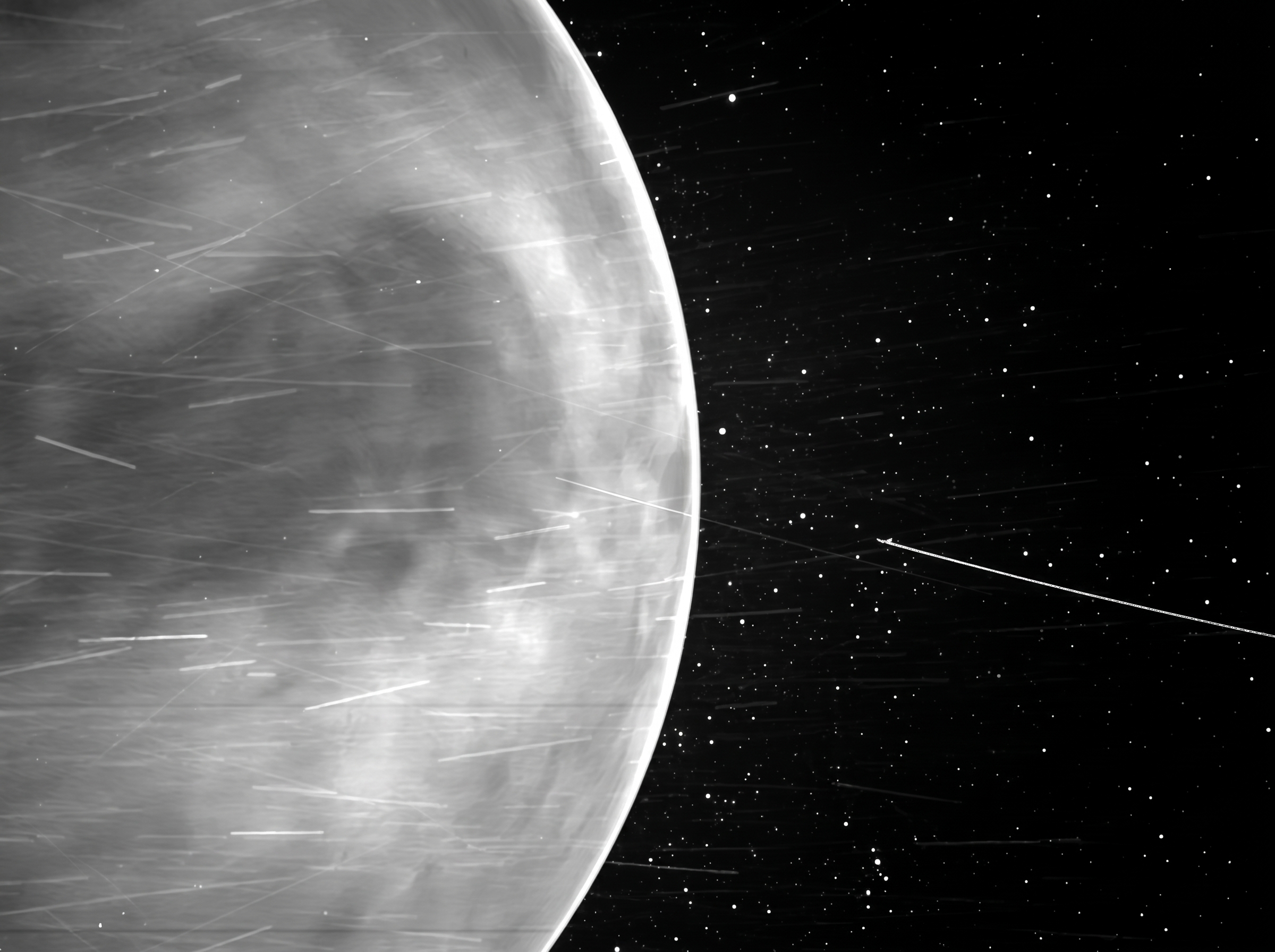
A study reveals that Venus may have swallowed a moon, reshaping views on planetary evolution and the search for habitable worlds.
Introduction
Recent research from the University of California, Riverside, sheds new light on the mysteries surrounding Venus, suggesting that the planet may have consumed a hypothetical moon rather than losing it to a catastrophic event. This finding significantly alters our understanding of Venus's evolution and its implications for the search for life beyond Earth.
Venus's Rotation and Its Effects
The second planet from the Sun, Venus, is often compared to Earth due to its similar mass, size, and structure. However, unlike Earth, Venus has no moon, leading scientists to speculate about various scenarios of its loss. The conventional theory suggested that a massive impact could have obliterated the moon. Contrarily, the new study proposes that gravitational forces from Venus’s slow rotation gradually pulled the moon inward, causing it to fragment and be absorbed into the planet.
The Research Findings
Research lead Steven Kane, an astrophysicist, explained, "Venus didn’t require a catastrophe to arrive at what we can see today." The study reveals that the slow rotation period of 243 Earth days—longer than the planet's year—combined with gravitational interactions, might have prevented the moon from escaping.
Researchers crafted a computer model that simulated interactions between celestial bodies to observe how Venus could have consumed its moon over time. The simulations indicated that under various conditions, the hypothetical moon would spiral inward and eventually succumb to the planet’s gravity.
Differentiating Among Planets
Interestingly, the researchers concluded that planets with slow rotations, like Venus, have a significantly higher likelihood of consuming their moons, while Earth’s comparatively fast rotation pushes its moon away at a rate of about 1.5 inches per year.
This study could also deepen our understanding of exoplanets. Planets identified as Earth-like—potential candidates for habitability—could face similar risks of retaining their moons based on their rotational speeds.
Implications for Life on Venus
Importantly, the fate of a moon may hold clues to whether Venus ever had conditions capable of supporting life. The process of a moon being absorbed would have imparted considerable energy to Venus, potentially altering its rotation, geology, and climate.
While this study does not provide definitive proof of a past moon, it opens avenues for future research. Geological evidence on Venus is challenging to decipher due to volcanic and tectonic activities that have updated its surface. Seismological surveys similar to those used in Earth could yield insights into Venus's history.
Conclusions
The potential absorption of moons by planets with slow rotations, like Venus, provides a fresh perspective in the ongoing search for habitable worlds beyond our solar system. According to Kane, "There are benefits to having a moon, but it isn’t required for habitability." Understanding these dynamics will be crucial as scientists continue to explore the universe for Earth-like planets.
Popular news
Harvey Weinstein receives 15-year prison sentence for sexual assault of Miriam Haley, concluding years of legal battles in the #MeToo movement.





Subscribe to
our news
Get the most important updates and top stories in your inbox.